
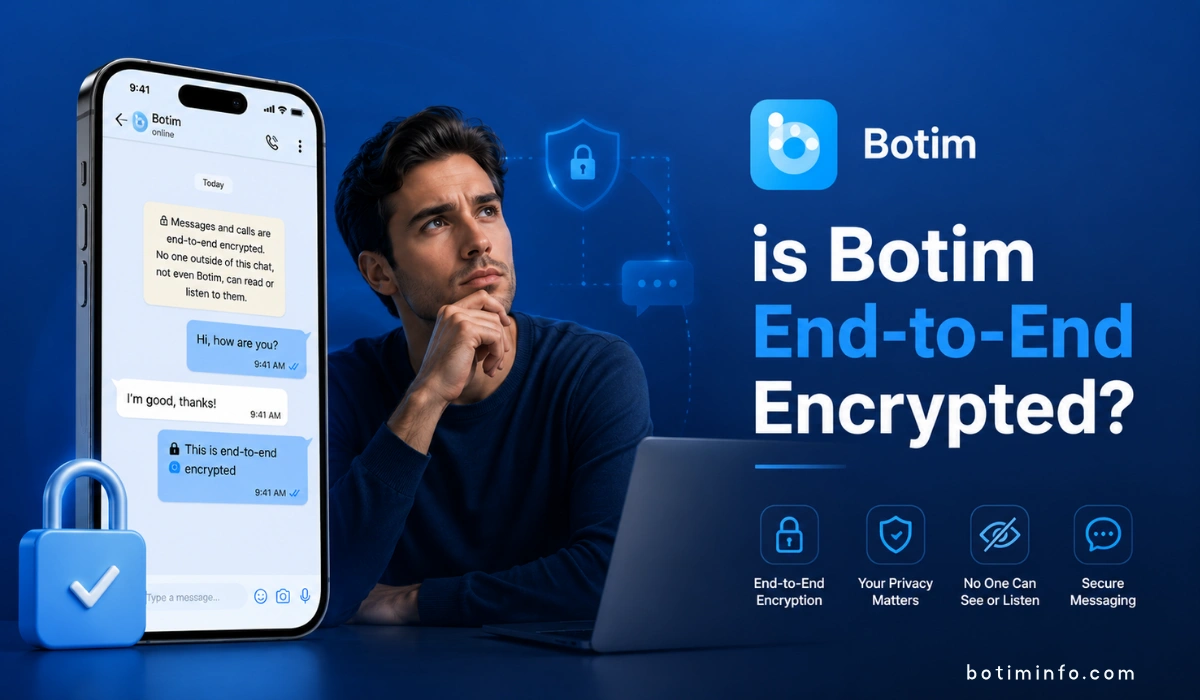
Quick Answer: Yes, Botim uses AES-256 bit end-to-end encryption for all private chats and video calls. Only you and the person you are talking to can access the data. Not Botim, not its parent company Astra Tech, not any third party. Nobody can intercept, read, or listen to your conversations.
In 2026, Botim is not just a calling app anymore. It has grown into a full AI-driven fintech platform and that means your financial data is in there too.
For UAE users, understanding what is actually protecting your conversations and your money is genuinely worth knowing. This guide explains exactly what is happening with your data, without all the confusing tech talk.
The Technical Reality: AES-256 Bit Encryption
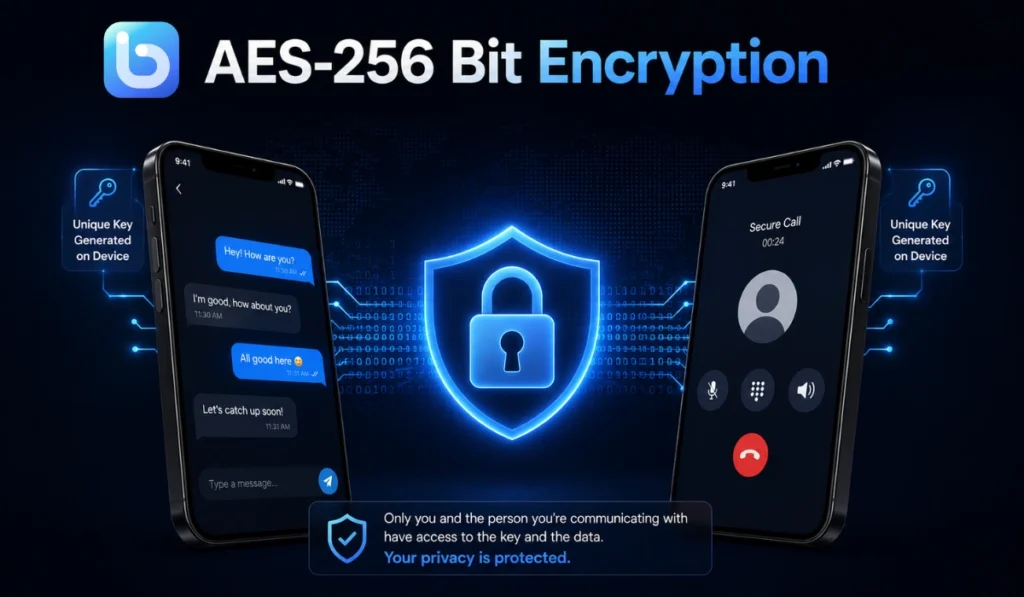
Botim runs on the Advanced Encryption Standard with a 256-bit key. Same thing global financial institutions use. Same thing government agencies rely on.
When you send a message or start a call, the app generates a unique cryptographic key right on your device and that key exists only on your phone and the recipient’s phone. Nobody else has it.
Cracking a 256-bit AES key with even the world’s most advanced supercomputers is statistically impossible. Your private data stays private.
How End-to-End Encryption Works in Botim
The core of Botim’s privacy is something called the “Zero-Knowledge” principle. Unlike standard cloud messaging where the service provider might hold a backup key to your data, Botim’s setup does not work that way.
Here is what that actually means:
- Source-to-Destination Locking: Data is encrypted on your handset and only decrypted on the receiver’s handset. Nowhere in between.
- No Server Interception: Your decrypted messages never pass through or sit on Botim’s servers. Ever.
- Call Privacy: Voice and video packets are scrambled locally, so any “man-in-the-middle” attack gets the attacker nothing useful.
- Session-Specific Keys: Each conversation gets its own unique key. Old keys cannot unlock new sessions.
This is not the okayish halfway version you get with some apps. It is the full thing, done properly.
UAE Privacy Laws and Data Sovereignty
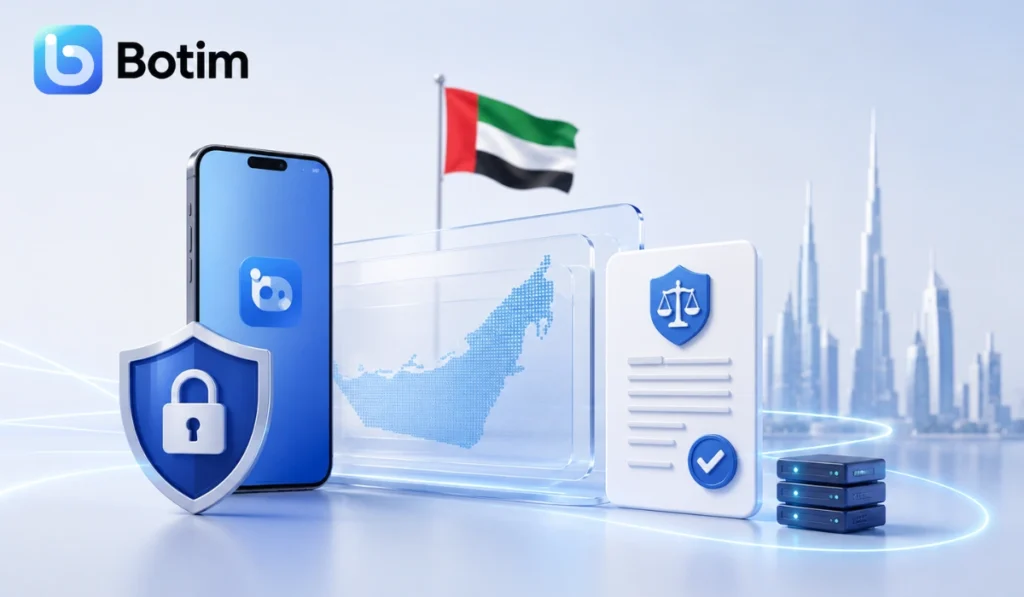
Botim is fully compliant with UAE Federal Decree-Law No. 45 of 2021 on Personal Data Protection. This law sets strict rules for how user information is handled inside the Emirates and it is honestly tougher than most people expect.
The app does collect minimal metadata, stuff like account registration details, and that is normal for any platform that needs to function. But the actual content of your communication is never stored or shared with anyone.
In 2026, Botim’s infrastructure is built to keep UAE user data secure within localized, protected systems. Not sitting on some random global server somewhere.
Security for Botim Financial Services
Since Botim now handles payments, payroll, and the Botim VIP Card, the security goes beyond just messaging. There are extra layers specifically built for the financial side and they are decent.
Here is what is protecting your money:
- PCI-DSS Standards: All financial transactions follow global Payment Card Industry Data Security Standards. This is the same framework banks and card networks use to prevent fraud worldwide.
- Aani Instant Payments: Your Aani transfers run under the same high-level encryption as your messages and every single transfer requires biometric or PIN authorization. Every dirham you send needs your approval.
- Biometric Authentication: Face ID and fingerprint unlock cover both your chats and your wallet. It is a physical security layer that encryption alone cannot provide and it is genuinely useful.
- Layered Protection: The combination of PCI-DSS compliance, E2EE, and biometric verification means your financial data has multiple independent barriers. Breaking one does not break all of them.
But the encryption and the financial compliance working together is what actually makes this setup solid. One without the other would be okayish. Together they cover most real-world threat scenarios.
Privacy Comparison: Botim vs. WhatsApp vs. Telegram
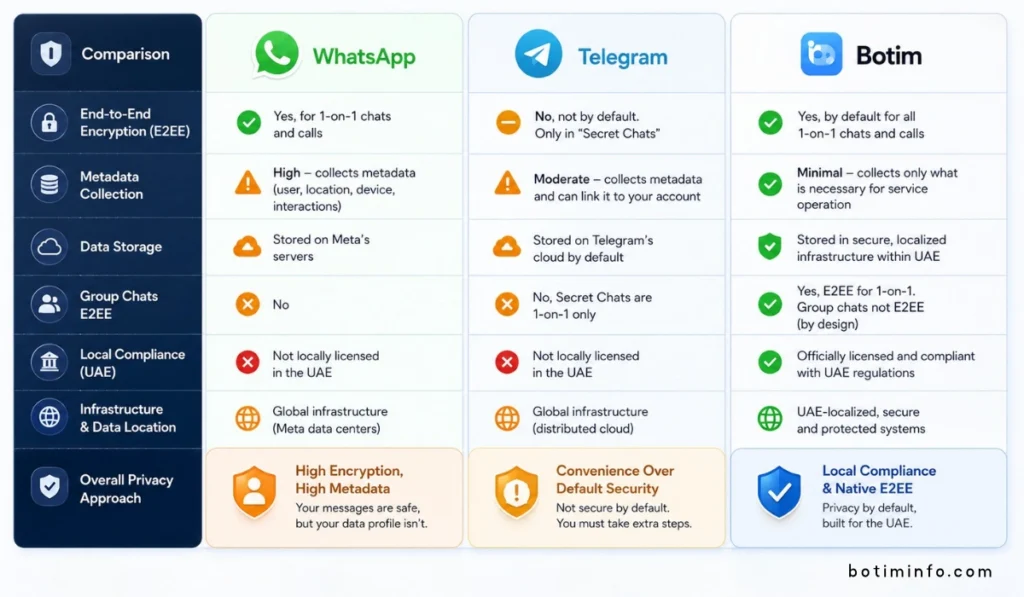
Choosing the right app depends on what you actually value most. Here is how the three compare in 2026.
WhatsApp: High Encryption, High Metadata
WhatsApp uses E2EE for messages and that part is genuinely solid. But Meta owns it and they collect a decent amount of metadata about you, who you talk to, how often, your location and device info.
That metadata gets used to build advertising profiles. The content of your messages is safe but the pattern of your life is not. That is the real tradeoff here.
Telegram: Convenience Over Default Security
Telegram is widely misunderstood. By default, regular one-on-one and group chats are not end-to-end encrypted and they are stored on Telegram’s cloud. The company technically has access to them.
To get actual E2EE you have to manually start a “Secret Chat” every single time and those Secret Chats do not work for group conversations at all. So any group chat you are having is sitting on their servers, not locked on your phone.
If you are using Telegram for private talk, you are basically trusting the company to behave themselves. Most people do not realize this is the situation until it actually matters.
Botim: Local Compliance and Native E2EE
Botim provides native E2EE for all one-on-one calls and chats by default. No setup needed, no manual steps, it just works that way from the start.
For UAE residents it has a distinct advantage. It is officially licensed and optimized to work inside the Emirates without the connectivity issues or VPN requirements that international apps sometimes run into.
How to Maximize Your Privacy on Botim
The encryption handles the technical side but there are four more things worth switching on. Most people skip these because the app does not push you to set them up during onboarding.
- Two-Step Verification (2FA): Set a secondary PIN in settings. Even if someone intercepts your SMS code they still cannot log into your account without this.
- App Lock and Biometrics: Enable Face ID or fingerprint unlock inside Botim settings. Anyone who physically picks up your phone cannot open the app.
- Manage Linked Devices: Check the Linked Devices tab regularly. A lot of people are still logged into Botim Web on some old office laptop without realizing it. Log those out immediately.
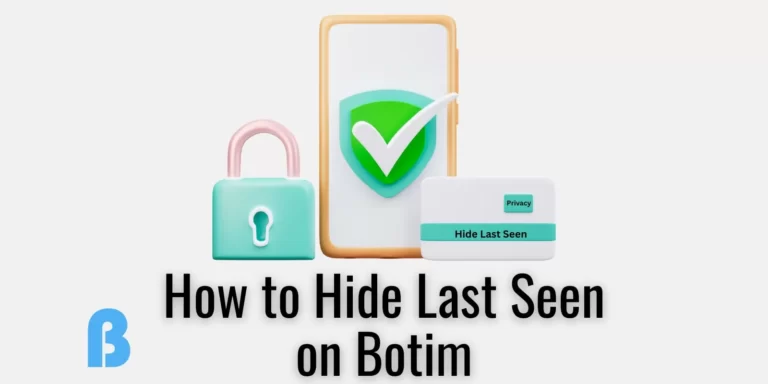
- Invisible Mode Settings: Restrict your “Last Seen” and “Status” to contacts only. Scammers and random numbers cannot track when you are active online.
And just to be clear, the one thing encryption cannot protect you from is someone taking a photo of their screen with another device. That is a people problem, not a tech one.
Final Verdict
Yes, your data is safe on Botim. The AES-256 encryption is real and the Zero-Knowledge setup means nobody, not even the company itself, can read what you send or hear what you say.
Even with all the quantum computing talk going around in 2026, AES-256 is still the industry standard for long-term data protection. Nobody has cracked it. Nobody is close to cracking it.
Combined with strict UAE data law compliance, Botim is genuinely one of the more secure communication options in the Middle East right now. Whether you are using it for personal talk or business transactions, it holds up.
What do you think? Do you feel safe using Botim for private calls, or do you have a different go-to app? Drop your thoughts in the comments and share this with someone who has been wondering the same thing.

bank statement